Delegating Work to Experts

Today I got to test what it is like to drive Southern California freeways in the rain.  It had been a while since I did this and I stupidly thought I needed a “booster shot”.  Aaaah! So. Cal is filled with idiots that don’t know what it is to slow down- even in driving rain with low visibility. The reason for the journey was to deliver both my “leather cone clutch” and our rare BRIGGS magneto to experts that both live and work in Orange, California.  The clutch (photo below) went to Mr. Bob Knaak (who has repaired hundreds of these clutches over the years) for a tune up on the little spring things that go around the perimeter of the clutch and push the leather out a bit.  If the leather gives out, that may get replaced too.

DSCN1787The “spring things” sit underneath the leather and the screw part goes through a little hole on the inside of the outside edge of the aluminum clutch plate.  You can see some of these that aren’t broken in the photo above. They have hex nuts on the ends of the screws for adjustment.

The “spring things” are shown in the photo below — after being pried out from under the leather. More about how these function etc. in the Leather Cone Clutch section of this website.

DSCN1788

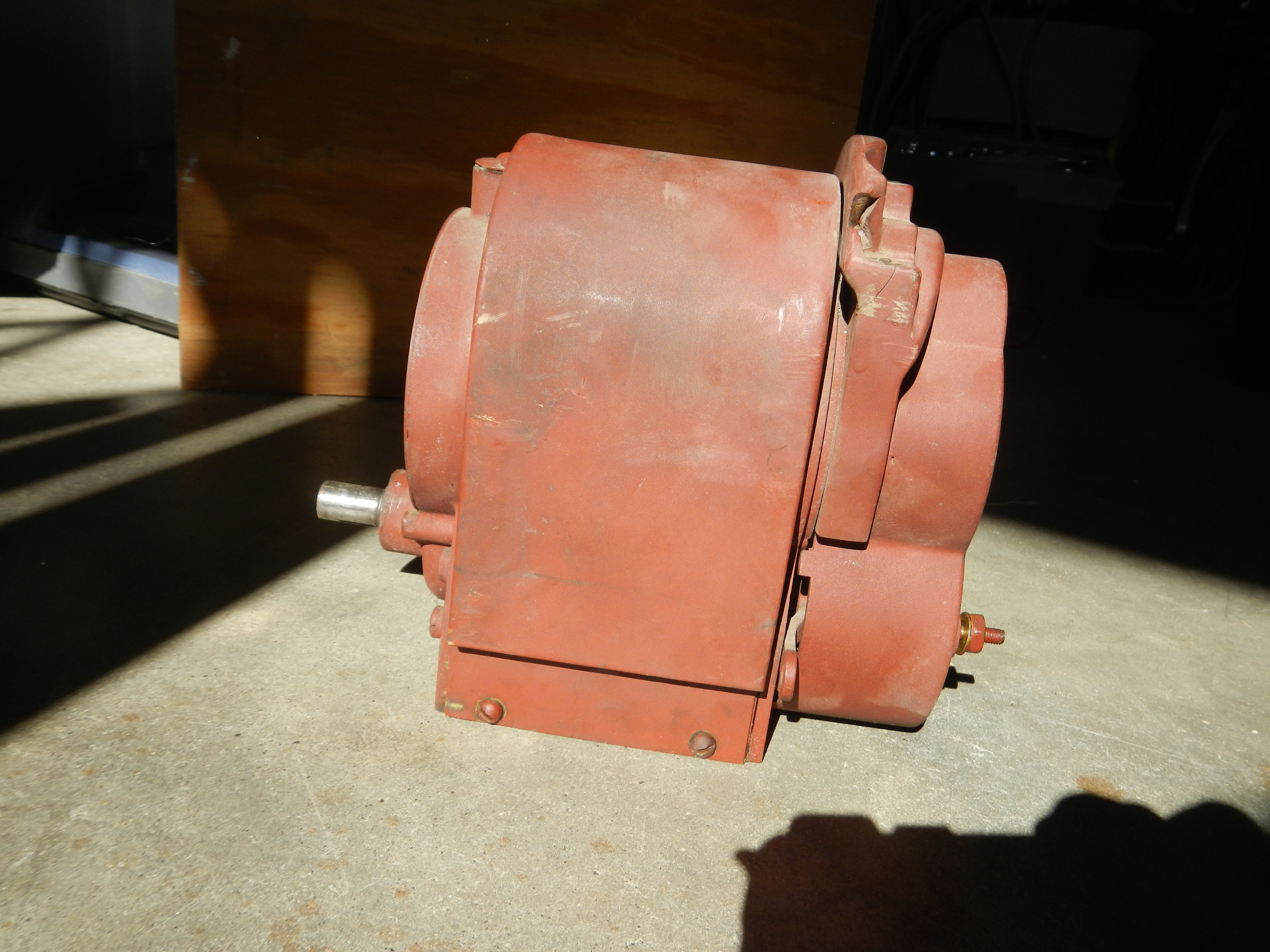
I also got to visit Mr. Carl Bloom who is known as a magneto expert and has an amazing shop filled with all sorts of meters, gauges and sundry electronic stuff. Not quite like Dr. Frankenstein’s lab— but impressive nevertheless.  Carl has done many magneto repairs but my BRIGGS will be a first for him. The magneto is essentially a generator with a distributor or commutator on the end to distribute the spark to the spark plugs.  Ours needed to be checked out and tuned up so that when I get ready to start the Michigan, it is sparking in all the right places with sufficient juice.   I look forward to getting word back from both gentlemen on their progress towards returning these parts of the Michigan to proper working order.

The Briggs Magneto ignition and coil box (no keys — just a big switch):

DSCN1981

The magneto itself looks like this:

Out of the car:


DSCN1986


In the car, below:


DSCN1966


The MIGHTY MICHIGAN 40 HP Engine –by BUDA Motor Company

This is the LEFT side of the BUDA motor for the car. The front bottom of the photo shows from left to right the following items: oil pump, water pump, magneto. Above that running along the top of the engine are four little cups with levers. These are priming cups for putting a little gasoline directly into the cylinders prior to trying to start the engine.The far right wooden box holds the ignition wiring and coils.

Click on the photo to enlarge.

DSCN1933This is the RIGHT side of the BUDA motor for the car. At the bottom left you see the steering column going right by the very hard to see carburetor. Above that is the exhaust manifold (it hides the intake manifold in this photo). Next up you see a series of eight circles with notches in them. These are called “valve chamber plugs” in the MICHIGAN parts list for 1912. This engine does not have a “head” that bolts on top of the cylinder block.  I am told that this type of engine is called a “jug” engine. Each valve chamber plug has another hole in the center and in this photo has either a spark plug or an acetylene injector.

Click on the photo to enlarge.

DSCN1931Okay.  What the heck is an acetylene injector? Good question. Until I first saw this car in 2011, I had never heard of such a thing. Apparently, in 1910, 1911 & 1912 car companies were experimenting with ways to start cars without having to crank them by hand. There are many stories about broken arms, or worse related to crank starting cars and having the ignition set in the wrong position resulting in dangerous kick-backs. Moreover, who wants to be in front of a car that may jump forward and run over you? Or, cranking out in the rain or snow?

During this particular period there were many different technologies that were tried for starting motors. These included, wind-up springs, compressed air, electric motors and acetylene.  This car has the fairly rare acetylene starter manufactured by Prest-O-Lite, called the Prest-O-Starter. I’ll post more about this starter later.We know which starter style won the competition ……. and it wasn’t acetylene. Thanks to the innovators at Cadillac, we all use electric starters these days….. and have done since 1912.
 

Stops Along the Way to California


One of our first stops on the return to California was just West of St. Louis, Missouri to see John Fleck (in the blue shirt on the right), Grandson of Michael Fleck. John said he remembered playing on the Michigan when it was stored in a garage in Hobart, but he never saw it running. We hope to be able to give John a ride sometime in the future.


We didn’t slow down on our trip West, except for a brief stop outside of Shawnee, Oklahoma to visit the Citizen Potawatomi headquarters.  Here Tori and I are parked in the lot across from the Cultural Center (below).

Both Tori and I are tribal members through my Mom’s side of the family.


We also stopped in Amarillo, Texas for a boot shopping adventure — and to tighten the tie-down straps for the Michigan. Tori needed some boots to complete her Southern California surfer chic wardrobe. Clearly they protect the toes much better than flip-flops.


Moving the Michigan to California

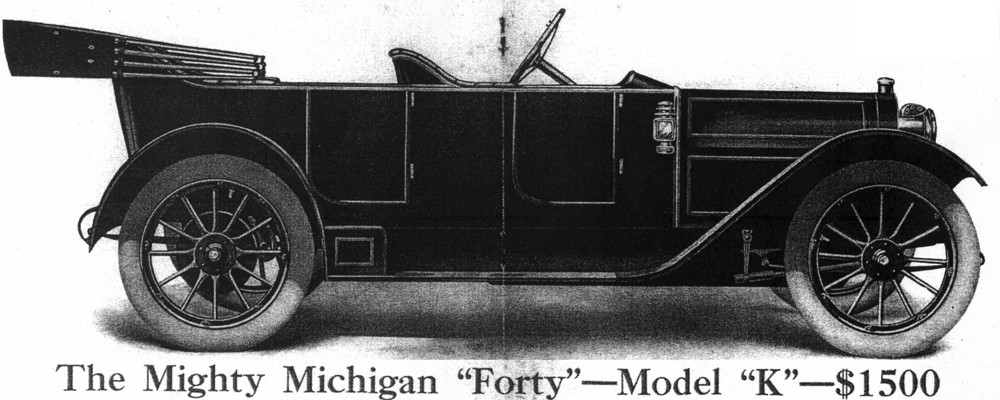
On July 9, 2013 we picked up “the big long trailer” in Cresco, Iowa and set out for Hobart Indiana. Michael Fleck, the original owner of the Michigan had lived in Hobart when the car was purchased in 1912.  We  had moved it there for temporary storage in a barn on Janet’s family’s farm back on September 18, 2011.


On July 11, 2013 we uncovered the Michigan, cleared out some of the mothballs placed in it to keep out the rats, racoons and possums and pushed it out of storage for loading into the trailer.  In this picture (above) Kyle White helps me (Craig) push the Michigan towards the trailer.

Here, Victoria Correll and Kyle White pose with the car.  Victoria (Tori) is a Great Great Granddaughter and Kyle is a Great Great Great Grandson of Michael Fleck.

DSCN1577Janet Correll is helping guide the Michigan on to the trailer ramp before we used a come-along and chain to ratchet the 3000+ pound car into the trailer.


Early Vehicle Registration — 1914

This is what a document from the DMV (before it was called DMV) looks like.  The service was probably pretty good too.  It seems that the original signature of the Indiana Secretary of State is on each vehicle registration form.  I don’t know about your state, but we don’t get service like that very often in California. I note that the horsepower notation is lower than the advertised 40 horsepower of the BUDA engine in our car.  Interesting.  Perhaps a lower license fee if the horsepower is lower?

Click on the photo to enlarge

Michigan Reg. 1914 & envelope

Michael Fleck’s 1914 Automobile Registration Certificate for our MICHIGAN. It is accompanied by the envelope in which the certificate was mailed.

Note that the ENGINE NUMBER (477567) is used as the “factory number” and that the horsepower is listed as 36, and not 40.


Our Car – 1915

So far, we only have two photographs of the car then owned by Michael Fleck.  This first photo was supplied to us by John Fleck of Chesterfield, MO., the grandson of Michael.  The photograph shows John’s uncle, William “Bill”  Fleck driving the car  with his wife, Mayme seated immediately behind him.  The location is the corner of Third Avenue and Main Street in Hobart, Indiana during the Fourth of July Parade in 1915. We don’t know who the other two mostly hidden passengers are. One passenger could easily be Clare Fleck who would later inherit the car from her father Michael. Someday it would be great to  be in the Hobart parade with the car restored.

Corner of 3rd Street & Main Street, Hobart, Indiana – July 4, 1915

The car is decorated for the parade and is difficult to see what is under the bunting. Nevertheless, you can see that the car is big, has right hand drive.  The corner has changed a bit in the 100 intervening years.

NE corner of 3rd & Main, Hobart, Indiana in 2014

The second photo taken the same day was found in 2014, by Clarence Davis at the Hobart Historical Society museum, mounted on a display panel.

A second photo of our Michigan car found by Clarence Davis at the Hobart History museum.

The second photo was presumably taken by the same photographer, Fred Rose, who became Mayor of Hobart a few years later. Rose also served as a Hobart volunteer fireman with Michael Fleck as shown on our How We Became Custodians of the Michigan blog entry. The photo is a bit less blurry, but the bunting and decorations obscure the details of the car. Note the teddy bear siting on the improvised “cow catcher” between the headlights.  Was this a nod to Teddy Roosevelt?

Barns Are for Animals?

As we readied the Michigan for it move back to Hobart, we took time to remove loose items, trash and shredded upholstery from the car. In the process we disturbed a very angry chipmunk. We had demolished his very comfortable horsehair and leather nest.

Janet & trashed upholstery

The varmints playground

A seriously angry chipmunk – click on photo to enlarge (a bigger & angrier chipmunk)