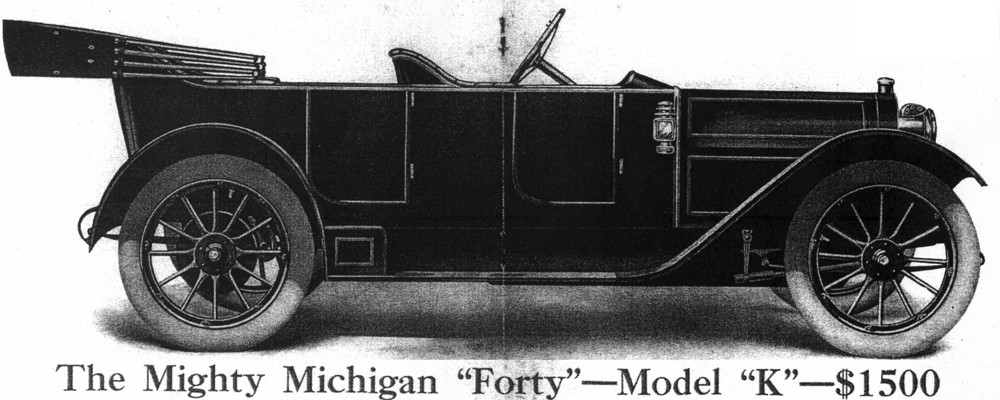
Our car has a rare, short-lived, and allegedly dangerous acetylene self starter made by the Prest-O-Lite company. (see my notes on the Prest-O-Starter at: https://michiganmotorcar.com/nuts-bolts-2/prest-o-starter-acetylene-starter/ Cars earlier than ours often had acetylene generators which were complicated and messy. Instead of an acetylene generator, our car came stock with an easy to use Prest-O-Lite tank mounted to the right running board. The tank supplied acetylene gas to both the headlights and the Prest-O-Starter. Our family photos of the car show this tank.
Fleck family July 4, 1915 parade, Hobart, Indiana. (click on photo to enlarge)
This very same tank (or one that was swapped into place back in the 1900’s) was with the car when we took it out of Steve Dickey’s barn in 2011. It should be noted that 1912 was a pivotal year in the rapidly evolving automotive technology scene. The 1913 Michigans did not have acetylene for headlights or starters. Both were upgraded to something we would recognize today – electricity. Both light bulbs and an electric starter were new for 1913.
Craig displays the Prest-O-Lite acetylene tank, Sept. 17, 2011.
While it would be unwise to actually refill the tank, we nevertheless wanted to display this authentic accessory. So, I pulled the tank from storage under a workbench and got to cleaning it up and gave it a coat of paint.
Prest-O-Lite tank showing evidence of use and warning label.
Unfortunately, the tank’s nickel plating had worn off and corrosion had removed much of the copper plate labelling. So I used some “chrome” rattle can spray paint as a nickel plate substitute. Aesthetically it was a good alternate for the shiny nickel plating at a fraction of the cost. The application of a copper colored sticker added the verbiage that was on the original label.
Restored acetylene tank, ready for mounting on the running board.
Brackets and tank installed.
I should note that when I got ready to clean the tank, I opened the valve. There was a faint hiss and I got a whiff of genuine 1900’s acetylene. But it’s all gone now. If we get our lights (and maybe the starter) set up some day, we will use a modern tank hidden somewhere else on the car.
So, we’ve been on several trips since my last post. Mostly around Carlsbad and down the coast on Highway 101, Pacific Coast Highway (or Carlsbad Boulevard, in the City of Carlsbad). The longest of these has been about 25 miles or so. Overall the car has been behaving well. I’m still learning how to upshift (fairly easy) and down shift (really difficult). There is a reason these pre-synchromesh transmissions are called “crash-box” transmissions. Matching the speed of the driving gear with the speed of the driven gear while the car is in motion is not easy. The rear wheels of the car are spinning and that spins the differential and drive shaft all the way up to and including the output shaft (and gears) of the transmission. All of this is independent of how fast the input shaft from the engine and clutch are spinning when the car is in neutral. These gears must mesh if you are going to shift from one gear — 2nd up to another gear 3rd or from 3rd down to 2nd to slow the car – such as on a hill. Simply moving the gear shifter to the next gear (up or down shifting) does NOT mesh them. The result is a clash of gear teeth that makes a horrid grinding noise as the gears cry out that they are not synchronized. Until you hear it, you won’t appreciate how cringe inducing it is. Oh, and your passengers will know you are a rookie.
For those of you that are unaware, synchromesh gearing was introduced in 1928, by Cadillac, after being invented by Earl Avery Thompson in 1919. Virtually all manual transmission vehicles use synchromesh transmissions to get transmission gears to synchronize before full engagement. Thank you Mr. Thompson, I really appreciate you because of what we DON’T have in our Michigan’s transmission.
The way to avoid gear grinding is to carefully match the speed of the back end of the transmission with the speed of the gears at the front, with input from the engine. This is typically done by “double clutching”. It is a technique that is mostly extinct, because crash box transmissions are mostly extinct too. The process is thus on a down shift: Push in the clutch, move the shifter from 3rd gear to neutral, let clutch out, rev the engine a bit as the car slows down, push in the clutch, move the shifter from neutral to 2nd gear and let out the clutch. That’s the procedure, but its a symphony of motion and attention to speed and engine RPM’s. Get it wrong and it’s a grating chattering wince inducing operation that lets you know it just ain’t gonna happen. So the car slows down while it is now out of gear– unless you are on a hill, in which case you may accelerate. (Oh dear!) The net result is that a missed “double clutch” shift will probably require stopping and then shifting up to the gear you were trying to hit. Again, a rookie move and your passengers will know by your demeanor (and the lack of any forward progress) that something is amiss. With double clutching you have a chance. Without it you’re just trying to smash it into gear. You wanted to rebuild the transmission anyway. Didn’t you?
The rounded or tapered edges on the gear teeth show where the grinding occurs. Synchromesh would add several thin spinning gears between the driving and driven gears to smoothly guide them into full mesh. This eliminates the “crash” of the crash box. (click on photo to enlarge)
When not grinding gears, the operator of an antique vehicle is well advised to have a sharp ear for strange noises. Clunks, plinks, roars, chatters, knocks, and explosions. Because I destroyed the third cylinder connecting rod bearing shortly after I first started the car back in 2017, I have a particular sensitivity to knocks. The destruction of the #3 bearing was preceded with ominous knocking sounds that quickly grew louder and LOUDER. (see my comments about the problem at: https://michiganmotorcar.com/2017/05/) So while doing all this recent driving around (about 200 – 250 miles or so) I had noticed a knock that would occur at not very specific times. It worried me. So on January 25, 2023, I put the car up on stands and drained the oil – all 3 quarts of it. A remarkably small volume, considering the size of the engine. While it was dark and dirty looking, there were no obvious chunky or broken bits in the sludge. Only a fine fuzz of magnetic goop clung to the magnets I had installed on the drain plugs. This was a very good sign.
Oil in the pan looked dirty, but was free of chunks, and sparkly flecks.
Inspection of the crank shaft and connecting rod bearings showed no movement or slop in any direction. This was very good, indeed.
Crank & connecting rod bearings #3 & #4 – flywheel to the far right.
So, my knocking noise is coming from some other unknown area. At times like these, Click & Clack, the Tappet Brothers from National Public Radio would say, “Turn up the music and keep driving.” Ah! But wait, that’s another technology that had not been commercially introduced until 1930 or so — the car radio. I guess I will just have to enjoy the wind in my ears and ignore the knock until it presents itself in such a way that I can identify its source or origin. (Crosses fingers and looks skyward.) I put magic RTV sealant on the pan lip, pushed it up into position and bolted it back in place. Three quarts of 30 weight and we were ready to go. And she did.
Our first test drive with REAL honest to God brakes that work was December 4, 2022.
Come on. Jump in. Let’s take her for a spin.
Janet & Craig enjoy a ride in the Michigan that can now both go and stop.
We put 15 miles on the car and effective brakes really DO make a difference. The car works almost like new. Just a few more details and she’ll be completely done. Note however that the experts in the field tell us that “completely finished” is an illusive goal.
As the prior post indicates, our Michigan is actually driving around town and carrying passengers. Like a real car. Except the driving experience is not without some tension. The car does NOT like to stop on slight grades without really standing on the brake pedal and in some cases, applying the hand / parking / emergency brake. That last maneuver (using the hand brake) takes a slowly kind-of-slidy reduction in speed and makes it a grabby jerky skiddy inelegant sudden stop. On actual hills – not so much. It’s sort of a phone in your suggestion to slow down and stop and then see – belatedly – if that is actually going to happen. I haven’t wound up in the middle of an intersection — yet.
So how come these brakes don’t work? If you have been following along, back in October of 2021, I had worked on the brakes with my brother in law, Clarence Davis, while we put new seals in the rear end.( So Many Things to Adjust ) At that time, I had cooked the brake bands – both pedal brakes and hand brakes) in a degreasing solution to try and remove nearly 100 year old gunk that had saturated the woven – probably asbestos – brake lining.
Well, that attempt was pretty much a failure. The car, once set up to run didn’t want to stop. So, it was time to reline the brake bands. I ordered 2 inch wide high temperature woven friction material from McMaster-Carr (high strength brake & clutch lining – item #6224K345) which seemed to be the right stuff. I could not locate the “green gripper” material that I have previously used on our Model T accessory brakes. I also ordered 1/8″ diameter copper rivets to fasten the 3/16 thick material to the steel bands. (Item 97440A330 & long version 97440A340). The plan was to attach the material with original J B Weld epoxy (good to 550 degrees F) and then drill & rivet the material on.
November 26, 2022, I started the brake project by removing the axles from the rear end portals so the wheels could be removed. The wheels have to come off to get access to the brakes. The brake drum itself is bolted to the inside of the rear wheels.
Axle shaft on its way out. The axle itself is about 3 feet long.
Left wheel off and the brake drum is DRY! No oil leaks to be seen.
I was very very excited to see that the work that Clarence & I had done with new felt seals had succeeded in keeping the brake drum and backer plate completely dry. This meant that the brakes were not bad because of a seal failure. The problem was the lining material itself. And that was what I was in the process of replacing. This really was a relief. The right side was just as dry and I texted Clarence with photos so he could share our oil seal success.
Right brake drum and backer plate equally DRY. Hooray!
The evidence of the lining failure was a coating of black goop mostly on the outside of the brake drums and the edges of the lining.
Goop squished out of the old linings and on to the drums.
Every time the brakes were applied, the band heated up a bit releasing more goop and lubricating the brakes. More heat equals more goop equals less friction. That is a really bad combination. The more you need the brakes the less they work. Once removed I took them to the workshop to grind off the rivets and peel the linings out.
Up on stands, wheels off and brakes removed.
Grinding old copper rivets off.
After removing the old linings, I media blasted the rust and accumulated crumbly bits off the bands, sprayed the non-lined sides with self etching primer and glued the lining in place. Good contact was maintained by using many clamps.
Glued inner (hand) brakes and clamped exterior (pedal) brake with clamps.
The contrast between the old linings and the new linings is easy to see.
Old greasy oily linings and pristine new linings installed on refreshed brake bands.
And then, I installed them.
Mr. Brakejob installs the hand brake – expanding band on the right rear.
Does this man need a brake? Well, maybe for lunch. Ham sandwich and a coffee?
On September 25, 2022 we drove up to Fresno to pick up my Dad who was very anxious to ride in our nearly completed car. Remember, he came down in July, but the car wouldn’t start on the old magneto – so we only got a photo op – no actual driving involved. We had a nice visit with my sisters and headed home the next day. Dad & I worked a bit on adjusting the brakes and worried about the valve chamber plug leaks in preparation for a test drive.
Dad applies brake pressure and I check adjustment.
Then we were set for a test ride.
Testing for water and other leaks before a test ride.
Pop is ready to GO!
YIPEE!
Over the next couple of days we found out that the Gano water filter was catching enough goop to immediately clog up and cause poor circulation and overheating. So, we removed it and put a section of straight pipe in its place. As of the date of this writing, we have yet to have an overheating issue with the Gano filter gone. I may decide to put it back in simply to clear gunk out of the system — but only for short periods and no long journeys.
Our trip on October 1, 2022 was 21 miles up and down the coast with a top speed of 40 mph. That evening I added some new water pump packing material to slow the leak on the water pump shaft.
The next day we went on an even longer ride, 26 miles down the coast and back. The car is running remarkably good. It got warm once while idling, but otherwise stayed cool. Everyone was having a blast. Especially – Pop.
Janet, Tori, Pop, Craig & Chris visit the Smith’s in Cardiff.
On October 3, 2022, my sister, Mindy, came down from Fresno to retrieve Pop, but took her inaugural tour in the Michigan before driving the 6 hours back north.
Sister Mindy takes her first ride in the Michigan.
Generally speaking the car is running pretty good. It goes — just like a real car. But it doesn’t like to stop. Yeah…. it’s back to looking at the brakes.
The new tuned magneto has since behaved itself. The starting routine that seems to work best is as follows:
Open valve on gas supply line next to the carburetor
Pull out the choke wire
Turn the engine over 4 or 5 cranks
Push in choke wire
Get in car, verify in neutral, push in clutch pedal
Adjust gas to 1:00 position and spark to 1:00 position
Turn switch to BAT.
Push Shower of Sparks button.
Turn switch to MAG. after it starts.
Normally that will start the car……. Except when it is warm. That routine has yet to be perfected.
On August 31, 2022 we started up the car and went out to visit friends. We picked up Bryan & Carole Gunner and then proceeded to visit Dave & Anita Trotta, where their son Nick, climbed aboard and we drove a short distance through the neighborhood.
Craig, Nick Trotta, Bryan & Carole Gunner get a brief ride.
We probably put a total of 10 miles or less on the car, but it was overheating at every stop.
When we returned home I set out to see if a Gano coolant filter I had installed might be plugged. It was. It appeared to be small fibers and rusty goop.
Rusty gunk and fibers in the Gano filter.
Clogged Gano filter – other side.
After cleaning the filter, I could see that there was considerable oil and water around the threads of the valve chamber plugs. A bubble or two was also present. So I removed them. This was obviously a compression leak and perhaps something more sinister.
Bubbles and oil around the threads of the valve chamber plugs.
Front 4 valve chamber plugs removed. Oily valve tops.
I decided to remove the water jacket cover as well and try to see if we had a cracked or leaking piston or a hole in the water jacket that might penetrate the cylinder wall.
Putty knife used to break the sealant and separate the water jacket cover from the block.
Water jacket cover opened showing tops of cylinders and coolant galleries full of water.
The height of the water was reassuring (indicating small or no leaks). I then re-installed the valve chamber plugs without the spark plugs and filled each cylinder with compressed air as I rotated the fly wheel to a “valves closed” position and looked for bubbles. There were none. On the compression stroke, the compressed air would push the piston down, rotating the flywheel part way. This was true for both “suspect” cylinders. Trapped air could also be released through the priming cups. All in all, this was a very reassuring result. No apparent leaks in the water jacket and reasonably tight piston rings. I suspect the culprit was the copper ring gaskets I made to replace the old flattened ones I had removed from the valve chamber plugs. Standard sized replacement gaskets were not to be had through any of the gasket resources available. They were either too large to fit in the recesses in the head or too small to go over the threaded plug. I had made solid copper wire rings and soldered the break. I think I will try stranded wire in the future to see if it seals more securely and crushes better than the solid annealed wire. The leaks prove that I’m not getting full power from the engine and that is a bummer. For the time being, I’m going to reassemble the plugs and gaskets as is, but with a bit more anti-seize paste and tightening the plugs a bit more. Maybe I can get them to seal up.
As reported June 20, 2022, the Bosch DU-4 Dual Magneto was working on the bench. The next day I started to make the modification of the dash board to accommodate the somewhat smaller diameter of the Bosch switch & coil vs. the larger diameter Briggs switch & coil. I got it all wired in and timed by June 29, 2022.
My custom turned collar and plywood back plate for the Bosch switch and coil.
Bosch switch & coil installed. The Briggs switch & coil & mag soon to be removed.
After completing the change over to the Bosch setup, we tried a start. It was miraculous. I primed the engine by pulling the choke wire, cranking the engine 4 or 5 quarter turns, switched the switch to battery and pushed the shower of sparks button. Pop pop pop vroom! She started right up! Hooray! Problems solved. Then I turned the switch to the Mag. setting and there was a slight change in the RPMs, but otherwise it was idling just fine. Eureka!
Janet & I took several short trips around the neighborhood to confirm that the car was running on both BAT. and MAG. It was. There was some stumbling when accelerating but this was probably an ongoing carburetor issue. NOT an ignition issue. We were happy and my Dad, sister Susan and her husband Dan were due for a visit in early July. We would have a lovely drive in our all but completed car………….
Ahem…….. not so fast buddy.
First it flung the cover for the interrupter (points) off into the street. Which didn’t cause it to immediately stop because the piece is only needed to short out the magneto circuit when you want the car to stop. We didn’t see it leave the car, but it couldn’t have been too far because our drive had been short. What is amazing is that we didn’t discover that it was gone until 2 days later. We drove along our route from 2 days before at about 2 miles per hour with our doors open looking at the street. Janet spotted it on the curb where some thoughtful neighbor placed it.
Interrupter cover for Bosch DU-4 Dual magneto. Found by Janet on the curb North-east corner of Hillside and Sunnyhill.
The cover went back on the magneto and we got another couple of rides out of the car over the next few days. The last time we took it out before my Dad & sister arrived the engine got fairly warm. The Motometer on the radiator indicated HOT, and the overflow pipe was spewing steam. We had gone on a “long” ride — about 5 to 7 miles. The engine was stumbling when it limped back into the garage. Not a good sign.
For context, you must remember that this magneto (the “new” Bosch) is over 100 years old. It had been sitting unused for probably 80 years. That insulating resin in the coils and windings hasn’t been in a hot engine compartment for a long long time. It could melt and fail at any time. And it did.
When my Dad, sister and hubby Dan arrived all ready for a ride in the newly completed Michigan – it refused to start. Not a cough or sputter. The “new” magneto was dead. We took pictures anyway – even if we had to roll the car out and then back into the garage.
July 10, 2022 L to R: Dan Kehler, Janet, Susan Kehler, Vince Correll, Craig. All disappointed because the magneto failed. But the 48 star flags look nice on the radiator. They are 1912 appropriate – both Arizona and New Mexico joined the Union in 1912.
So……. we need to send the magneto off for repairs. Our Horseless Carriage consultants recommended Bob Smith, the MagnetoDoc of Gardenerville NV. On July 11, 2022, I called Bob, and let him know a heavy package was on its way to his place. Then I crossed my fingers. Would this be a long term solution? Only time will tell.
Two days later, Bob confirmed by phone that our troublesome mag had arrived. He noted that someone had reversed the base and had probably had it opened up during its prior life. I just wanted reliable — “Bob please proceed to fix what looks iffy or typically fails.”
I got our mag back from Bob on August 20, 2022. Would it work?
Freshly refurbished Bosch DU-4 Dual Model 5, magneto. This thing should work.
On August 23, 2022, I gleefully installed the mag and set to timing the car. It wouldn’t start. I retimed the car setting the fly wheel to #1 & 4 to TDC and watching the battery interrupter points just barely start to open as the fly wheel hit TDC — just as I had before. It wouldn’t start, just a single pop and maybe a backfire. I timed it again. One pop. I checked the battery. I timed it again to the magneto points. (This car has points for battery start and points for running on magneto– hence the word “DUAL” in the description. And they are a couple of degrees different.) No change – one pop and maybe a backfire when cranked. I let the car sit for a day or two. When things get frustrating, parts sometimes get broken. I called Bob and asked for advice. He said check the wiring.
I pulled the entire thing out of the car and put it on my bench testing rig. It all worked as it should. Nice strong sparks on BAT. Nice strong spark on MAG. Nice shower of sparks on single plug when set to BAT and shower of sparks button pushed (also called trembler button). Everything works. Hmmmm. What’s wrong with my install?
Bench testing the Bosch DU-4 Dual Model 5 magneto. Everything worked as it was supposed to work.
Since the entire wiring harness was out of the car, I decided to upgrade the stranded ground (positive from battery) wires to a large terminal lug end that would fit the 3/8″ mounting bolts for the magneto bracket. Otherwise, I changed nothing. I reinstalled the magneto, timed it to the magneto points (not the battery points) and attempted a start.
Pop pop vroom. We have ignition. Yea. Finally. Jeez what a hassle.
I reported my success to Bob Smith who was pleased to hear that our Michigan was alive. That was on August 28, 2022. It is time to go test the car some more and see what else will unscrew itself or fall off.
About mid-June of 2022, I contacted Robert Gagnon, a highly recommended pin striper. I’d first heard of Robert, and met him at the Fallbrook Vintage Car Show back in 2019, before the Covid pandemic. We traded information and I sent Robert photos of Michigan cars taken in the 1910’s. Each photo (go to:https://wp.me/P45zSY-8M) shows a bit of striping on the cars. Our job was to reproduce as close to original as possible the location and color of the stripes for the 1912 Michigan Model K. This meant, the hood and body were pinstriped – but the fenders and wheels were not. The advertising literature from the Michigan Motor Car Company indicates that the color of the pin striping was WHITE for the deep olive green cars. (go to: https://wp.me/P45zSY-7A The striping would generally follow this pattern:
The yellow line shows the approximate location of pin striping for the 1912 Michigan Model K.
Robert arrived at 8:30 am on June 22, 2022, with his car full of striping materials. The first order of business was to confirm the color of the stripes. While the advertising says the stripes were WHITE. There are lots of whites and some look better than others. Our decision was to have the stripes match the light grey of the wheels. A couple of test stripes on the deep olive green car confirmed that matching the light grey wheels was the preferred color – and it still stood out as “white”. Striping took about 6 hours and Robert completed it all in one day – with tired knees and wrists. First he carefully taped the curves to help guide his steady hand, but the tape was merely a guide for the paint brush. And the result was really stunning. The curves and beads in the body panels really popped after getting the accent added by pinstriping. Thank you Robert Gagnon. It looks great!
Taping before striping.
Robert adds striping to the engine hood.
Tape was a guide – not an edge for the striping.
The finished product. A beautifully striped and shiny car. Click on photo to enlarge and appreciate how far we have come. Woo Hoo!
On April 30, 2022, we packed up the Michigan in the “big white trailer” and headed South to drop it off at Ernie Romero’s shop. The car was to get a new top. Ernie had done a fabulous job on the upholstery and it only made sense to have him do the top as well. We had seen several others Ernie had done and they all look beautiful. The plan was to restore the top, side curtains and boot exactly as the original. And we had all the tattered, rotted, vermin pooped top parts to serve as patterns — including original side curtains, which very few cars of this age ever have. See top photos and a further explanation at: https://michiganmotorcar.com/nuts-bolts-2/folding-top-side-curtains/
Tori & Chris help unload the car in El Cajon near Ernie’s place.
We left the car, the new Haartz custom fabric and various fasteners with Ernie and headed home.
Ernie and I discuss the process of getting the top, side curtains and boot put together.
We got several progress reports from Ernie that showed the stages in putting a top on a horseless carriage. Just like a buggy, our car has top bows that need to be in just the right position if it is to go up smoothly and lay down nice and compact.
Top bows need to be in the correct positions if the top is going to work correctly and look smooth.
It is just the back, but that fabric looks amazing.
We needed to drop off some straps and fasteners, so Janet & I did an inspection tour on June 2, 2022. The car was looking great.
Janet & Ernie examine the side curtains – both new and old.
A few days later, Ernie sent us some photos of the car with the side curtains installed. We had never seen the side curtains on the car before. If we ever need them, I think it will be very claustrophobic.
Side curtains installed.
On June 18th, Ernie called and said the top was finished. We made arrangements to pick it up on June 18, 2022. IT LOOKED FANTASTIC.
Ernie shows us how the boot works to cover the folded top.
Slow backing uphill without power steering. Craig looks a bit concerned. But the boot looks GREAT!
Winched in, tied down and ready for the trip home.
From early on, we’ve had both warnings and suspicions about our Briggs Magneto.
Only just now am I understanding that the sage advice from several magneto mavens should probably have been heeded.
But hey – “It worked on the original car. Why shouldn’t it work now?” Um… there are a host of reasons why not……. but I didn’t want to hear them. And as the car gets more complete and we deal with the OBVIOUS problems, the less glaring flaws assert themselves. This happens in small bursts with little revelations as we try our car out on the road. Mind you – we are talking about little drives to test stuff. One mile, three miles, 5 miles was the longest. In these short drives the car has been running on BATTERY – deriving all electrical power from the battery through a 21st Century standard automobile coil
Modern coil in the firewall mounted BRIGGS switch box
(replacing the resin block of wires in the original firewall mounted wooden box)
Original coil encased in some sort of pink resin and lined with mica insulation material.
and then on to an interruptor set of points in the main magneto housing and from there through the distributor section of the magneto to the spark plugs. If you switch it to MAG. (magneto) from BAT. (battery), the engine coughs, sputters and then dies. It ran rough on magneto for a while, but I wouldn’t call it anything approaching nice and smooth. This is after two visits to the magneto guy in Orange, CA. and spending a fairly significant chunk of change with him as well. Hmmmmm. That is not how things are supposed to go. Perhaps I should have listened to the early warnings regarding our Briggs mag.
So, when I start the car (or TRY to start the car) we’ve seen the front cover of the distributor portion of the mag try to unscrew itself from the rest of the mag. And on a different occasion, the entire distributor cap portion, including the cover, tried to unscrew itself from its mounting position. This is not a good thing. Not at all. This sort of unreliability of the component parts of the ignition system necessitates a ritualistic step by step approach to every attempt to start the car. It’s a fairly long list of ways it wants to misbehave electrically. You must: check the battery, check the switch, check the wires, check the mag cover, check the mag mounting screws, check this, check that, check the other thing. Check everything but the Czech Republic. Um…… as a fancier of horseless carriages, we enjoy the simplicity of these early cars………. up to a point (or a set of points – which, of course, should also be checked.) Oh, and the unscrewing itself trick — this happens while the machine is running. Performance deteriorates quickly into non-operational stasis. Bricked. Kaput. Tow it home. BAD MAGNETO — BAD!
So– I’m going to do what I understand most owners of Michigan cars have done over the years. Retire the Briggs and install a Bosch. Yes, that Bosch – makers of home appliances, power tools, modern car electrics, medical devices and probably a host of things I can’t think of right now. Anyway, Bosch has been making automobile ignition systems since about 1897…..and Bosch ignitions have been keeping autos going ever since. RELIABLY. In the early horseless carriage days, many ignition brands came and went. Eisemann, K-W, Splitdorf, National, Mea, Simms, Heinze, Pittsfield, Kingston, Remy, Herz, Duplex, Connecticut, No-Lag, U & H, and the list goes on. About the only brands that have survived are Bosch and Remy (Delco-Remy).
So I acquired a Bosch magneto setup. For this car, which needs to be able to be started on battery if I am ever to attempt to get the acetylene starter to function, the choice was a period correct Bosch DU-4 DUAL Ignition. “Dual” in the case of this particular version of the Bosch DU-4, means both a self sufficient magneto (not requiring a battery) AND a separate battery based ignition. Two separate switching positions and two separate sets of interrupter points. The BRIGGS magneto that came with our car was intended to be used this way – but appears to have only one set of points. Generally speaking, you start on battery (requiring MUCH less hand cranking effort) and once the car is running, you flip the switch to magneto – which does not draw down the battery.
My “new” Bosch Dual Ignition magneto and switch. Both somewhat encrusted with 110 year old loveliness.
With the two Bosch components in hand, (magneto and its separate dash mounted switch-coil) the cleanup began to get them working together as they were intended. The original documentation helped – but proved to be lacking in troubleshooting suggestions. At least ones that I could recognize and deal with.
The full manual is attached below. Click on the description.
As of the date of this writing, May 18, 2022, my bench testing shows the MAG. side of the ignition works as it should. The BAT. (battery) side does not. So – I may need some expert assistance to get this all working. With the BRIGGS, only BAT. works. With the BOSCH only the MAG. works. To know how this feels, play the recording, below.
BUT WAIT! Good news. For the next several days I went through the entire wiring setup AGAIN. I consulted the fellow that I bought the magneto from. I queried other horseless carriage owners. During such consultations, I was advised to change the wire leads on terminals 3 & 4 from 12 gauge wire to spark plug wire (high voltage insulated). That was nice and stopped some arcing at the back of the switch – but still no sparks at the plugs when switched to “battery”. Hmmmmmm.
Testing the Bosch magneto and switch
Better check all the connections again and clean the contacts everywhere. Including both sets of points (interrupters). Lets just check the gap on the interrupter for the battery setup. It looks like it’s opening and closing but maybe not. Let’s adjust it open a bit more. ZAP! We’ve got SPARK!
PROBLEM SOLVED! The Bosch DU-4 Dual Ignition works as advertised. This is very good news, indeed.